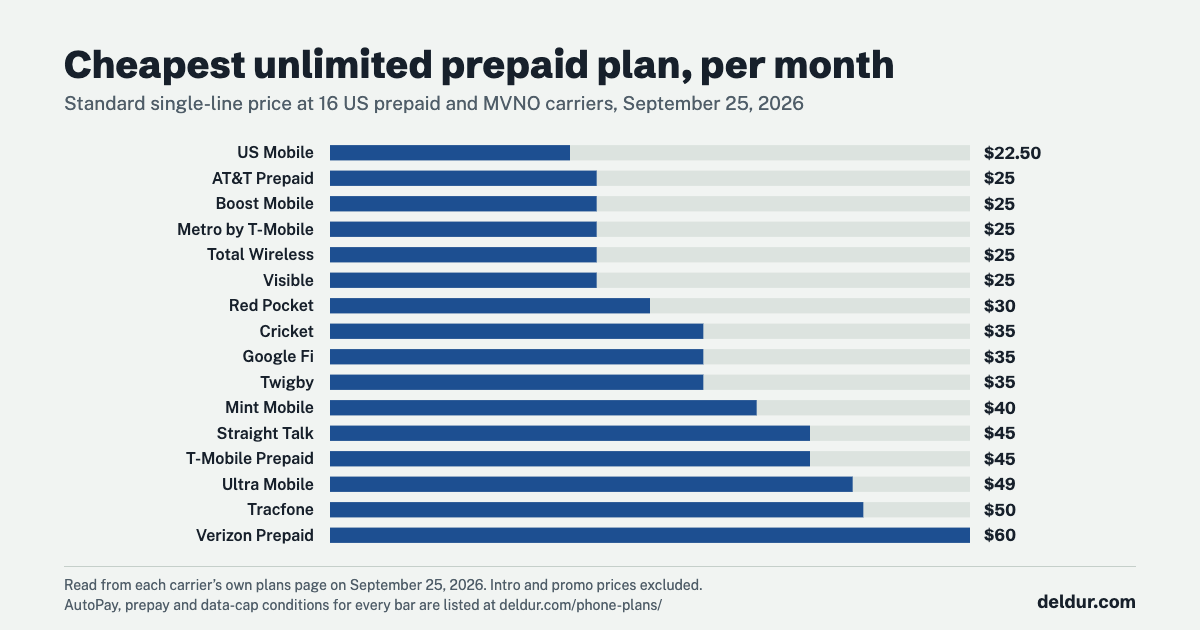
This is the first baseline of Deldur’s phone plan dataset. On September 25, 2026, every single-line plan on the official plans pages of 17 US prepaid and MVNO carriers was read and recorded: the standard price, the data allowance, the hotspot allowance, whether taxes are included, and every condition the page attaches to the price. The full table, with a source link for each carrier, is on the phone plans dataset page. This post is what those 80 rows say when you line them up.
$25 is the floor for a monthly unlimited plan, with five different sets of strings attached
Five carriers show a standard, monthly-billed price of $25 for a plan they label unlimited. The conditions are not the same:
- Visible ($25): taxes and fees included, and the page states no AutoPay condition. Video is capped at 480p and hotspot at 5 Mbps.
- Boost Mobile ($25): the $25 already includes a $5 AutoPay discount, so it is $30 without AutoPay. Taxes and fees are extra. Speeds “may be lowered to 512kbps” after 30 GB.
- Metro by T-Mobile ($25): taxes included, but the price is a web-only offer for customers bringing their own phone, requires AutoPay, and the first month is $30.
- Total Wireless ($25): taxes included, requires Auto Pay, bring your own phone. The same card also shows “$30 first month, then $20/mo after” for new customers, and the page does not make clear how the two figures relate.
- AT&T Prepaid ($25): online only, new single line only, taxes and fees extra, and the data is capped at 3 Mbps for the first 30 GB and 1.5 Mbps after that.
Only Visible’s $25 has neither an AutoPay condition nor a tax surcharge stated on the page. That is a statement about what the pages say, not about network quality, which this dataset does not measure.
Everything under $25 for unlimited requires paying months in advance
Four plans come in below $25 a month for unlimited data, and none of them is billed monthly. Metro’s 6-Month Unlimited is $20 a month but $120 up front. AT&T’s 12-month plan is $20 a month but $240 up front. US Mobile’s Unlimited Starter displays $16.58 a month, which is the first-year price of $199 divided by twelve; it renews at $270, or $22.50 a month. Mint’s Unlimited is $30 a month on its 12-month term and $40 on its 3-month term, and every Mint plan is sold in 3, 6 or 12-month blocks. Across the whole dataset, 22 of the 80 rows are per-month equivalents of an upfront payment rather than a monthly bill.
Taxes are included at 5 of 17 carriers
Visible, US Mobile, Cricket, Metro by T-Mobile and Total Wireless state that taxes and fees are included in the listed price. The other twelve say the opposite in one wording or another: “Taxes & fees extra” (Mint), “Taxes and fees apply” (Boost, Straight Talk), “Monthly prices do not include taxes and gov’t fees” (Google Fi), “Prices do not include fees or taxes” (Tracfone). Red Pocket goes further and itemizes a regulatory recovery fee of $1.00 and an admin fee of $0.25 to $0.75 per month on top of tax. For a $10 plan that is a 12.5% to 17.5% surcharge before tax.
AutoPay decides the headline price at 7 carriers
Boost, Cricket, Metro by T-Mobile (six of its seven plans), Total Wireless, T-Mobile Prepaid, Tracfone (as Auto-Refill) and Verizon Prepaid all print a price that depends on AutoPay. The gap is $5 a month in most cases and $10 at Verizon Prepaid on plans of $45 and up, where the discount only starts after the first month. Straight Talk’s three-month promotional prices also require Auto Pay. The remaining carriers state no AutoPay condition on their plans pages.
Introductory pricing is now the default presentation at 11 carriers
Eleven of the 17 carriers lead with a price that is not the price after the first term. Mint shows $15 a month on every plan “for initial plan term only.” Visible takes $6 off for a year with a promo code. US Mobile shows a first-year figure and prints the renewal price in smaller text. Tello labels every price on its page an introductory rate and does not print the regular one. Ultra Mobile, Boost, Google Fi, Twigby, Straight Talk, Red Pocket and Metro (on its 6-month plan) each have a new-customer discount that runs one month to twelve months and then ends. The dataset records the standard price in the price column and the promotional price in the conditions column, so the two never get mixed.
What is not in this baseline
Consumer Cellular and H2O Wireless are missing because their plans pages could not be read that day. Straight Talk and Tracfone were read from their homepages for the same reason, so Tracfone’s 90-day and 365-day plans are not yet listed. Tello’s post-introductory prices are not printed anywhere on its page. These gaps are listed on the dataset page and will be closed as the pages become readable.
Later updates: H2O Wireless’s plans page became readable on September 26, 2026, and its three plans were added to the dataset. On September 28, 2026 every carrier was re-read with no price changes, and a first-year cost comparison was added. Later that day Consumer Cellular’s plans page was read and its six plans were added, with two Tracfone prices corrected. The figures above are the September 25 baseline and are kept as published.
How this dataset will be maintained
The carrier pages are re-read on a regular schedule. When a price or a condition changes, the dataset page is updated and the change is recorded in its change log with the date, the old value and the new value. Third-party comparison sites are never used as a source, and nothing on Deldur is an estimate. Deldur has no financial relationship with any carrier in this dataset. How the site works is explained on the About page.